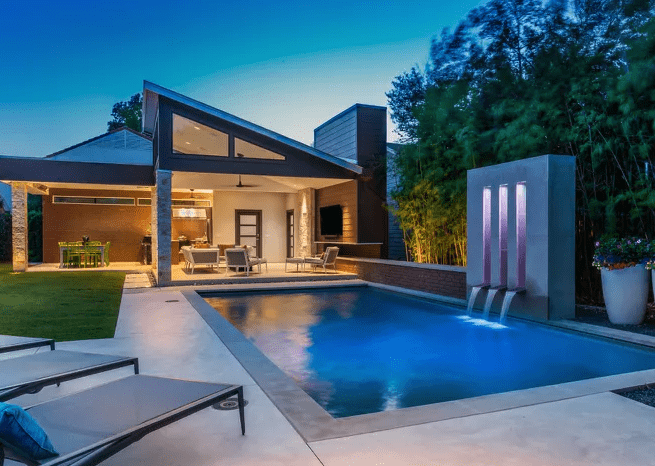
A pool is one of the most energy-intensive and maintenance-heavy assets on a residential property. Pumps running on fixed timers regardless of solar availability. Manual chemical testing that happens when you remember rather than when it’s needed. A spa that takes forty minutes to heat up because you forgot to turn it on before you left work. A pool cover sitting open because no one checked the wind forecast.
We integrate your existing pool and spa equipment directly into Home Assistant — pump, heater, spa jets, lighting, motorised cover, robotic cleaner — and build the automation logic around it. The same pool. The same equipment. Running smarter, cheaper, and with far less of your attention.
Your pool pump is likely one of the highest-draw appliances on your property. Running it at the wrong time of day on a time-of-use tariff costs significantly more than it needs to.
We integrate your pump controller into Home Assistant and replace the fixed timer with intelligent scheduling:
Solar-aligned filtration— The pump runs when excess solar generation is available, using power that would otherwise be exported to the grid at feed-in rate. Free filtration, paid for by your panels.
Off-peak fallback— On days without sufficient solar, the pump runs during off-peak tariff windows — overnight or early morning — at the cheapest available grid rate.
Peak rate suppression— If the pump is running when peak tariff starts, it pauses automatically and resumes when the rate drops. You set minimum daily filtration hours, the system finds the cheapest way to hit them.
Variable run time by season— Summer filtration requirements are higher than winter. We build seasonal logic that adjusts daily run time based on month, water temperature, or a combination of both — without manual adjustment.
Run history on your dashboard— Total daily filtration hours, last run start and end, and running cost for the day — all visible on your Home Assistant dashboard alongside the rest of your energy data.
Manual testing is the weakest link in pool maintenance. It happens on a schedule that suits you, not on a schedule that suits the pool.
We integrate water quality monitoring devices into Home Assistant for continuous visibility:
pH monitoring— Continuous pH readings surfaced on your dashboard. Threshold alerts pushed to your phone when pH drifts outside your defined range — before it becomes a problem for swimmers or equipment.
Chlorine and ORP monitoring— Oxidation-reduction potential readings that indicate sanitiser effectiveness in real time. Dashboard gauges with alert thresholds.
Water temperature— Live pool and spa water temperature on your dashboard. Spa preheat automations triggered by temperature — the spa starts heating automatically to reach your target before a scheduled time.
Salt level— For salt water pools, salinity monitoring with dashboard visibility and low-salt alerts before the chlorinator loses effectiveness.
For properties with existing automated dosing systems, we integrate the dosing controller alongside the sensors — so the system doesn’t just alert you to a problem, it corrects it.
The most common complaint about spa ownership is the heat-up wait. You decide you want a spa, then spend forty minutes waiting for it to reach temperature.
Scheduled preheat— Set a recurring spa time in your Home Assistant automations. The spa heater activates automatically to reach your target temperature before you want it. Saturday morning at 8am, the spa is ready at 7:45am without you touching anything.
On-demand preheat from anywhere— Leaving work? One tap in the Home Assistant app starts the spa heater from your phone. By the time you’ve driven home, parked, and walked inside, it’s ready. No voice command required. No waiting.
Voice trigger—“Hey Google, heat the spa”activates the heater from anywhere in the house. Confirmation comes back through the speaker. Dashboard shows current and target temperature with estimated time to ready.
Auto shutoff— Spa heater turns off after a configurable runtime or once it’s been idle for a set period. No leaving the heater running overnight because someone forgot to turn it off.
A motorised pool cover connected to Home Assistant becomes a genuinely useful automation device rather than something you operate manually when you remember.
Wind speed trigger— Your personal weather station feeds live wind speed data into Home Assistant. When wind exceeds a defined threshold — typically 25–30km/h — the pool cover closes automatically to prevent debris accumulation and water loss from evaporation.
Overnight closing— Cover closes at a scheduled time each evening, reducing overnight heat loss and cutting heating costs for pools and spas with heating systems.
Rain event response— Heavy rainfall detected by your weather station triggers the cover to open, allowing rainwater to enter the pool rather than run off the cover and potentially overflow.
Camera-triggered cleaning— If your pool camera detects significant leaf or debris accumulation on the surface, an alert fires and optionally triggers the robotic cleaner to run a cycle. Eyes on the pool without going outside to check.
Departure automation— When the last person leaves the property, the cover closes as part of the standard leaving routine — alongside the garage, alarm, and lights.
Most robotic pool cleaners run on a fixed timer or manually. With smart integration, the cleaner runs when conditions justify it — not on a schedule that ignores what the pool actually looks like.
Camera-triggered cycles— A camera positioned to view the pool surface detects debris accumulation and triggers a cleaning cycle automatically. The cleaner runs when there’s something to clean, not when a timer says so.
Post-storm cleaning— High wind or storm events detected by your weather station trigger an automatic cleaner cycle once conditions settle. The pool is clean after the storm without manual intervention.
Solar-aligned operation— Like the pump, the cleaner runs when excess solar is available. Free cleaning, powered by your panels.
Run history and alerts— Cleaning cycle history on your dashboard. Alert when the cleaner hasn’t run in longer than your defined interval — so maintenance lapses don’t go unnoticed.
Pool lighting integrated into Home Assistant participates in your home’s full lighting and scene system.
Evening scene— Pool lights activate at sunset as part of the outdoor evening routine. Colour and brightness match your preferred evening setting.
Party and entertainment scenes— A single dashboard button or voice command shifts pool lighting to a defined entertainment scene. Colour changes, brightness up, coordinated with outdoor area lighting simultaneously.
Security response— Unexpected motion detection around the pool area at night triggers pool and perimeter lights to full brightness as part of your security automation response.
Colour and dimming— Where your existing pool lights support colour or dimming, we integrate full control into the dashboard. RGB colour selection, brightness levels, and scene presets — all controllable by touch or voice.
Your pool and spa appear as a dedicated panel on your Home Assistant dashboard:
Everything visible at a glance. Everything controllable without going outside.
Does my existing pool equipment need to be replaced?In most cases, no. We work with your existing pump, heater, and controller hardware using smart relay switches, timer replacements, and controller integrations. Full equipment replacement is only necessary where existing hardware is incompatible or at end of life — we’ll confirm this during your assessment.
Which robotic cleaners can be integrated?Integration options vary by brand and model. Maytronics Dolphin, Zodiac, and Hayward cleaners have varying degrees of smart integration available. For cleaners without a smart interface, we use a smart power switch that gives Home Assistant on/off control sufficient for scheduling and solar alignment. Full cycle monitoring requires a compatible model.
Can you integrate my existing salt water chlorinator?Most modern salt water chlorinators can be integrated via smart relay or direct control depending on the model. We’ll confirm compatibility during your assessment.
Does the spa preheat work if I’m not on a schedule?Yes. The on-demand trigger via the Home Assistant app works from anywhere with mobile data. You don’t need a fixed schedule — you can trigger preheat manually whenever you decide you want the spa, from wherever you are.
What camera do you use for pool monitoring?We typically use a Reolink camera positioned to cover the pool surface and surrounding area. This gives you both security coverage and the visual data the AI cleaner-trigger logic needs. In many installations the pool camera doubles as perimeter security coverage for the rear of the property.
Can this work with an above-ground pool?Yes. The integration approach is the same — pump, heater, cleaner, and lighting all follow the same integration paths regardless of pool type. Above-ground pools typically have simpler equipment configurations that are easier to integrate, not harder.
Book a free consultation and we’ll scope exactly what smart pool automation looks like for your property and existing equipment.